
Independent Global Execution Risk Rating Bureau
Stabilizing Execution Under Distressed Operational Conditions
Turnaround scenarios are defined by unstable execution environments, fragmented ownership, and declining delivery confidence. Execution risk evaluation identifies whether leadership conditions can sustain recovery under pressur Read More

Benefits

Leadership Fit
Aligns leadership capabilities with distressed operating conditions, ensuring recovery mandates are executed by individuals structurally suited to high-pressure environments, constrained resources, and......
Read More
Recovery Stability
Execution risk evaluation ensures turnaround initiatives operate under structurally stable conditions, reducing disruption cycles and enabling consistent delivery during recovery phases where......
Read More
Structural Clarity
Identifies underlying coordination gaps, governance friction, and dependency misalignment, providing clear visibility into structural weaknesses that drive execution failure during turnaround efforts......
Read More
Controlled Intervention
Enables targeted, evidence-based intervention by identifying precise execution breakpoints, allowing organizations to stabilize operations without introducing additional disruption or reactive decision cycles......
Read More
Execution Continuity
Maintains consistent execution flow across recovery stages by aligning responsibility structures and operational conditions, reducing fragmentation that typically delays or destabilizes turnaround......
Read More
Risk Containment
Limits escalation of execution instability by identifying early-stage structural risks, allowing organizations to contain disruption before it propagates across critical systems and......
Read More
Evaluating Leadership Fit in Recovery Mandates
Turnaround success depends on whether leadership capabilities align with distressed operating conditions. This evaluation examines mandate requirements against execution environments shaped by urgency, capital constraints, and governance complexity. It identifies misalignment risks that may delay or destabilize recovery efforts. By assessing execution fit prior to leadership confirmation, organizations avoid reactive corrections and ensure that appointed leaders can operate effectively within constrained, high-risk recovery environments.
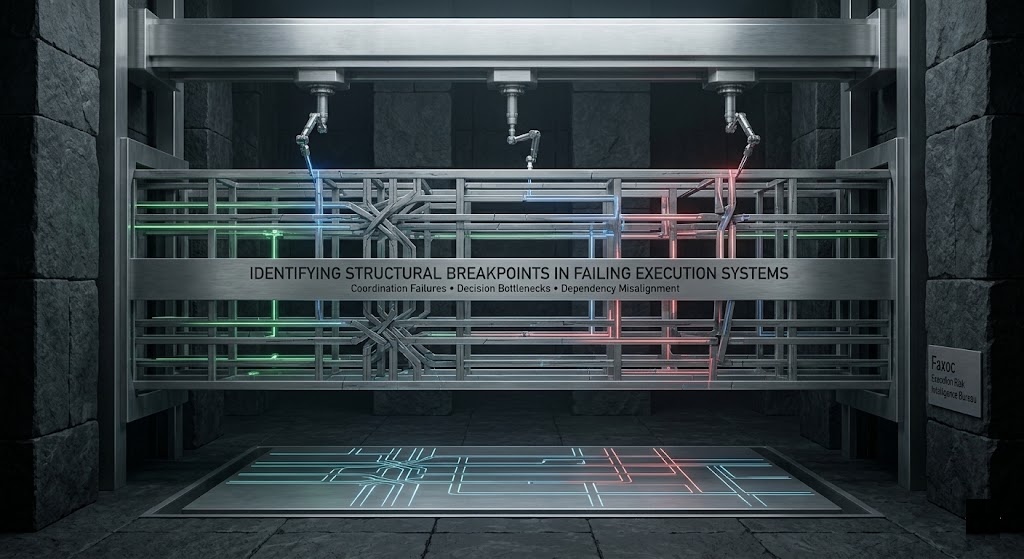
Identifying Structural Breakpoints in Failing Execution Systems
Execution breakdowns during turnaround are often driven by hidden structural weaknesses rather than visible performance gaps. This analysis maps coordination failures, decision bottlenecks, and dependency misalignment across organizational systems. It highlights critical breakpoints where execution is likely to stall or fragment. By identifying these structural risks early, organizations can intervene with precision, reducing execution drag and enabling targeted stabilization strategies across critical turnaround initiatives.

Enabling Controlled Recovery Through Execution Risk Visibility
Turnaround requires disciplined execution under uncertain and rapidly shifting conditions. Execution risk visibility provides a structured view of how governance, leadership, and operational systems interact during recovery. It allows organizations to monitor execution reliability, anticipate instability, and apply corrective controls before disruption escalates. This approach transforms turnaround from reactive intervention into a controlled, evidence-based process, improving the probability of sustained recovery and long-term execution stability.