
Independent Global Execution Risk Rating Bureau
Risk Intelligence Improves Visibility Into Leadership Execution Risk
Leadership decisions often rely on reputation, experience, and visible outcomes. While these signals provide context, they rarely reveal structural exposure within leadership mandates. Risk intelligence introduces a more analyt Read More

Benefits

Better Leadership Decisions
By evaluating mandate architecture and execution signals, organizations improve decision quality when selecting leaders for complex operational environments......
Read More
Reduced Execution Uncertainty
Risk intelligence clarifies how leadership experience interacts with structural conditions, reducing uncertainty around execution reliability during leadership transitions......
Read More
Stronger Mandate Alignment
Understanding structural execution signals helps organizations align leadership capability with mandate complexity and operational expectations......
Read More
Improved Organizational Stability
Analyzing execution environments reduces the likelihood that structural misalignment introduces coordination friction and delivery instability......
Read More
Greater Decision Confidence
Leadership decisions gain greater confidence when structural risk signals are examined alongside experience history and mandate architecture......
Read More
Earlier Risk Visibility
Risk intelligence identifies structural signals within leadership mandates, allowing organizations to detect potential execution exposure before operational instability begins to appear......
Read More
Structural Signals Reveal Hidden Leadership Execution Exposure
Risk intelligence focuses on identifying structural signals that shape leadership execution environments. Organizational span, coordination complexity, and operational dependencies influence how leadership decisions propagate across the enterprise. These signals often remain invisible when evaluation relies solely on experience or reputation. By examining the structural conditions surrounding leadership roles, organizations gain deeper insight into potential execution exposure before leadership appointments are finalized.
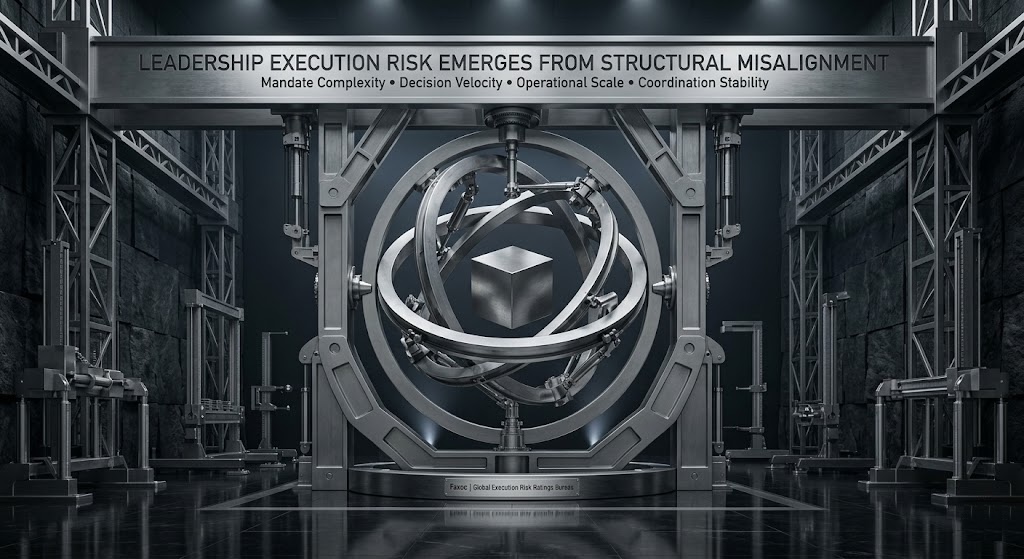
Leadership Execution Risk Emerges From Structural Misalignment
Execution risk frequently appears when leadership capability interacts with environments that differ from prior execution contexts. Mandate complexity, decision velocity, and operational scale determine how leadership experience translates into performance. When structural conditions diverge from leadership exposure, coordination friction and delivery instability may gradually emerge. Risk intelligence evaluates these contextual relationships, helping organizations understand whether leadership experience aligns with the structural demands of the mandate.

Risk Intelligence Strengthens Reliability Of Leadership Decisions
Organizations that integrate risk intelligence into leadership evaluation improve the reliability of critical appointments. By examining mandate architecture and execution signals, decision-makers gain earlier awareness of structural misalignment. This analytical perspective reduces the probability that execution instability emerges after leadership transitions occur. Risk intelligence therefore supports more informed leadership decisions by making execution conditions visible before mandates are confirmed.