
Independent Global Execution Risk Rating Bureau
Context Integrity Shapes Reliable Leadership Execution Conditions
Leadership outcomes depend not only on capability but also on the integrity of the surrounding context. Organizational structure, mandate clarity, and authority boundaries determine how leadership decisions translate into opera Read More

Benefits

Reduced Structural Friction
Aligned contextual conditions help minimize coordination complexity and operational disruption that often arise when leadership responsibilities exceed structural support......
Read More
Higher Leadership Reliability
Organizations gain greater confidence in leadership appointments when contextual integrity supports clear execution pathways and stable operational environments......
Read More
Stronger Context Alignment
Context integrity ensures leadership authority, mandate scope, and decision architecture remain aligned, enabling leadership capability to translate more consistently into reliable organizational......
Read More
Improved Execution Stability
When contextual conditions remain structurally aligned with leadership responsibilities, organizations experience greater operational stability and reduced likelihood of coordination friction across decision......
Read More
Earlier Risk Detection
Evaluating context integrity allows organizations to detect structural weaknesses within leadership mandates before execution instability begins to emerge during operational delivery......
Read More
Clearer Decision Authority
Maintaining contextual integrity clarifies authority boundaries and decision rights, reducing delays and fragmented accountability within complex leadership environments......
Read More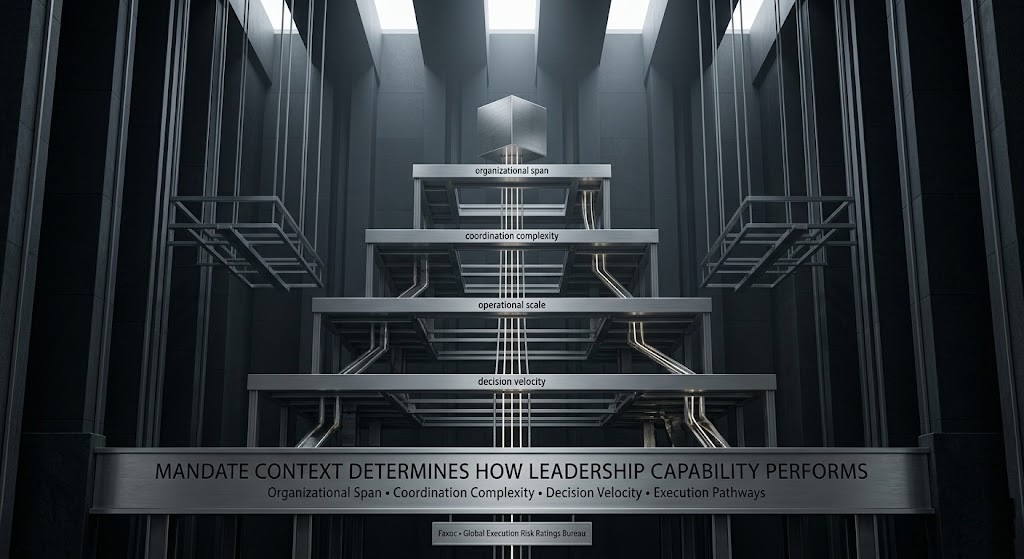
Mandate Context Determines How Leadership Capability Performs
Executive capability interacts continuously with the structural environment of the mandate. Organizational span, coordination complexity, and decision velocity influence how leadership decisions propagate through the organization. When mandate context aligns with leadership experience, execution pathways tend to remain stable. When contextual conditions diverge from prior execution environments, coordination friction and delivery instability may gradually emerge.

Structural Alignment Preserves Integrity Of Execution Environment
Execution stability often depends on the alignment between leadership responsibility and organizational authority. When authority structures, operational span, and decision rights remain consistent with mandate expectations, leadership execution becomes more predictable. Structural misalignment, however, can distort execution pathways by introducing delays, fragmented accountability, and unclear decision ownership.

Evaluating Context Integrity Reduces Hidden Execution Risk
Organizations that examine leadership mandates through the lens of context integrity gain earlier visibility into execution risk. By analyzing authority structures, mandate architecture, and operational span, decision-makers can identify potential structural weaknesses before leadership transitions occur. This analytical approach improves leadership decision reliability and reduces the likelihood that execution instability emerges after appointments are finalized.